
Senin, 18 Februari 2008

wayang still live in jakarta people


Image Courtesy by PERIPLUS

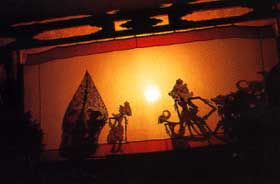
The cultures of Central Java, the source of art, music and dance, remains prevalent in Jakarta, representing much of what little most outsiders know of Indonesia. An important example of Javanese culture is the highly stylized wayang. This traditional puppet theater is based on the Hindu Ramayana and Mahabarata epics, combined with themes from Javanese folklore. Wayang is used to teach morals as well as to entertain, and is seen as a highly influential popular art form for spreading morality and social criticism.

Many politicians and successful businessmen are seen as dalang, the skilled men who control the puppets in wayang performances. Life in Indonesia has a way of working much like the plots of all-night wayang performances - slowly and with many unpredictable twists and turns.

Essential to a wayang performance is the gamelan orchestra, a set of bronze gongs and other percussion instruments including a xylophone, a type of two stringed violin and a flute or two. It may take some getting used to but, the sound of the gamelan, in both its Javanese and Balinese forms, has been compared to "liquid moonlight".

Wayang Orang (Dance Drama)
The stories of the Javanese Wayang Wong or Wayang Orang dance drama usually relate episodes of the Mahabarata and Ramayana Hindu Epics.

The Bharata Theater performs the Wayang Wong dance drama every Tuesday, Wednesday, Friday and Saturday evening. The performances start at 8.15 p.m. and last till about midnight.

Ketoprak
An offshoot of the Wayang Wong dance drama is the modern popular Javanese theater which takes its stories from popular folk legends and from history. Like the Wayang Wong, the Ketoprak show is accompanied by gamelan music but is simpler in costume and dialogue. Performances can be seen in Jakarta at the Bharata Theatre every Monday and Thursday evening, beginning at 8.00 p.m.

Traditional Indonesian Dances
Performances of traditional Indonesian dances from the various regions are on stage in Jakarta at Taman Mini (Indonesia in Miniature Park) every Sunday from 9 a.m. to 14.00 p.m. and at the Ancol Art Market every Saturday evening or Sunday morning.

Wayang Kulit (Leather Puppet Shadow Play)
Wayang Kulit, the leather puppet shows, are performed every second and last Saturday night of the month at the Central Museum in Jakarta.

The Wayang Museum in Fatahillah Square in downtown Jakarta stages abbreviated versions of the wayang kulit every Sunday morning. The performances last about one hour.

Betawi:


Indonesia's cultural diversity is celebrated in the national motto, Bhineka Tunggal Ika, meaning "Unity in Diversity." One manifestation of this tenet of Indonesian national identity is the government's efforts to give equal precedence to the development of traditional art forms from each ethnic group. In Jakarta, the Orang Betawi - the natives of the city - are considered to be the hosts of these cultures, having emerged from the melting pot of races, ethnic groups and cultures of Indonesia in the 19th century. Today they constitute one of the city's main ethnic groups along side the Javanese (from Central and Eastern Java), Sundanese (from West Java) and Chinese.

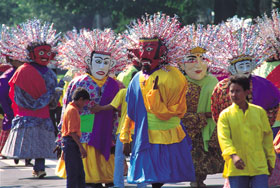
Betawi culture is a treasure trove of color, tradition, song, dance, clothing, cuisine, language and dialect. The culture thrives today due to government policy to enhance the cultural identity of the original inhabitants of the city, and prevent their traditions being buried beneath a tide of modernization. There are annual parades and other celebrations in which three-meter tall Betawi mascots (ondel ondel) - are seen delighting the crowds with their large masks and tinsel-sprinkled headdresses.

The language of the Betawi has been adopted by the fashionable younger generation of Jakartans from all ethnic origins, whereas the more formal Betawi Malay is only spoken by the more conservative older generation Orang Betawi.

Kamis, 14 Februari 2008

Living in The Minangkabau

Sheree recommended that I leave the steamy coast and visit Bukittinggi, a hill town famous for the unique Minangkabau expression of Islam. Two hours by car from Padang, its main streets are lined with restaurants, jazz bars and fast-food joints. There were constant calls to prayer from the great mosque, and behind them persistent tunes from ice cream trucks. Otherwise, since the 2002 bombings more than a thousand miles away in Bali, this once-thriving and still-fascinating tourist center has been far too quiet.

Yusmarni Djalius, a professor at Padang's Andalas University, had spoken to me of Bukittinggi as the heart of the world's largest matrilineal society, the Minangkabau. "High property" among the Minangkabau -- the land and the long, buffalo-horned houses that best establish cultural identity and authority -- is always inherited by women. And Djalius said Minangkabau husbands are in fact considered invited guests in their wives' homes. They can earn money and buy "low property" for themselves, but they understand it will rarely approach the pedigree, or the bulk, of what their wives have inherited and will pass down to their daughters.

Four million Minangkabau live on Sumatra. Strict Muslims who find no conflict with the Koran, they claim authority for their tradition in nature, where the female is everywhere seen to protect her offspring, and therefore the larger community, more fiercely and with more care than does the male. Frequently given better educations than the men, Minangkabau women seem to run most offices and banks in West Sumatra. When Djalius was completing her own graduate degree at Michigan State University, an adviser recommended that she take a women's studies course. She responded that she would much prefer to take a course about men. She had been raised, she said, to think of men as rather insecure.

(Back on the Laut India, McCarthy's Minangkabau cook had called a Minangkabau husband "a fly on a buffalo's tail." Although he has married a non-Minangkabau woman, he is proud that because of his Minangkabau upbringing, he and his wife have not fought once. He likes making most decisions, even financial ones, and yet he admits that things generally go better when women control the money. He was kind enough to offer me another bit of Minangkabau wisdom, that if mama's not happy, nobody's happy.)

Sheree had recommended a day trip to the volcanic lake Danau Maninjau, two hours west of Bukittinggi. When I hired a cab, Ilhu, a friend of the driver, asked if he could tag along. During lunch on the shore of the splendid crater, a restaurant owner wore a porcupine-quill necklace and handed me a business card identifying him as "Mr. Porcupine." When he spoke of cooking monkey and porcupine, it unsettled Ilhu. After our meal, Mr. Porcupine gave no warning when he uncovered a vat of squalid whiskey in which a deer fetus was half-submerged. I flinched at the sight of the slimy waxen thing, but Ilhu, who had just announced that his favorite food was KFC, was horrified by it. When it was time to head back to Bukittinggi, Ilhu said he felt sick and asked for the comfortable front seat. As I slumped down in the beaten-up back seat, I doubted that Ilhu, now chatting happily, was sick at all, and so when the car lurched through a cloud of bats, I asked him if he ever "ate bat." "Only when I get hungry," he answered after a moment. "KFB," he added.

This sharp young man spoke of moving to Chicago and of swimming in Lake Michigan. When I asked what would happen if people like him left Sumatra, he insisted that "Minangkabau will never die!" He lost patience when I assumed that Minangkabau women might have ceremonial power in a Muslim society, but nothing real.

I paid the taxi driver and thanked Ilhu. But before I headed back to Padang for my flight to Yogyakarta, I sought him out at the restaurant he had said belonged to his aunt. Smiling, coy and pretty, the aunt greeted me warmly as a customer, but when she understood I was only trying to locate her nephew, she lost interest. Still, she remained vaguely courteous and giggled at almost everything I said. But it became clear that she understood no English at all, and soon she was off doing numerous clanging things. When I tried to explain that Il had been an excellent guide, she did not get it and laughed and fluttered off to set another table.

To her back, I futilely explained that I had wanted to thank him . . . and give him . . . some money. She stopped setting the table. It took time before her head began its turn, and now the eyes that slid over my face were cold. "Tell me," she said in crisp, clear English, "how much money."

Betawi traditional music dancing


This is a Betawi-styled story which actually a sequel of Si Tomboy story. Si Tomboy found her adorable man named Bona. But the other group envy to her. The conflict arises but finally she can overcome them and gets married with Bona.

This performance is supported by 8 dances, music Gambang Kromong, Lenong, Tanjidor and Rebana. They will also perform marawis. The Betawi wedding tradition will be fully perform with Pencak Silat (traditional martial art) Buka Palang Pintu and Pasembahan/Kembang dance. There will also another Betawi tradition that will be staged such as Siri Dare, Crocodile Bread, Petisie, etc. Hopefully it will increase the children and teenager interest to love and appreciate the traditional art of Indonesia.

Betawi Wedding Ceremony

Last Friday, I visited another wedding invitation. But, this time, the occasion was still held in Jakarta. It took place at multipurpose hall of an Islamic boarding school , South Jakarta.

There are two main reasons why the wedding was quite special. First, both the groom and bride were my school-mates. Even though I met with the groom two times last month before the marriage I had never met with the bride since I graduated from Junior High School. Thus I really miss them. And the last, both are the real-native Jakartans or 'Orang Betawi Asli'. Certainly, the marriage was held using Betawi custom. And I am always happy to see and feel the aura of Betawi tradition. In my opinion, since Jakarta becomes the Capital City of Indonesia, the custom, tradition, and culture of Betawi are gradually extinct.

On one hand, the nuptial agreement was held on Friday morning. On the other hand, Friday is the day that people regularly go to the office. Therefore it was impossible for me to follow all the processes of Betawi wedding ceremony. I only caught up the reception or party in the afternoon. So I couldn't tell the complete story of Betawi marriage processes. However you can read this Indonesian-written article about the Betawi marriage. I apologize that I haven't got the English version.


I don't have pretty good knowledge about dress, design, and style. But, in my humble opinion, I really like the red dresses they wore. Absolutely beautiful, glamorous, and full of complicated motif.

Notice the furniture behind them! So Betawi nuance, unique, and ethnic I think. It reminds me the old days of Betawi. Before I moved to my current home at Depok, West Java, I used to stay in a place where there were lots of Betawi people lived. Some kind of nostalgia though.


A local band performing Qasidah and Arabic songs

As well as Dangdut and Jaipongan in Sundanese Wedding party, Betawi marriage also has an entertaining performance. It has a female-singer band. They performed some Arabic songs and Qasidah (dangdut-like music but more religious). The music instruments were minimalist and simple. There were only a flute, a keyboard, a guitar, and no drum. However, I loved the Arabic songs they played. That's why I think the band was pretty cool. Most of the Arabic songs' lyrics I heard were about love. Deep love of their beloved couple based on God. There is no pure love unless the love of God that is eternity and immortal. I understand a bit of Arabic language though :)


So that's the short and incomplete story of another Indonesian marriage which full of color, tradition, custom. I hope it could describe few of diversities of Indonesian culture.